Latest stories

Mars

M

Mars is the fourth planet from the Sun and the second-smallest planet in the Solar System after Mercury. In English, Mars carries a name of the Roman god of war, and is often referred to as the “Red Planet” because the iron oxide prevalent on its surface gives it a reddish appearance that is distinctive among the astronomical bodies visible to the naked eye. Mars is a terrestrial...

Lagrange Points

L

Lagrange Points also L-points, are the five positions in an orbital configuration where a small object affected only by gravity can theoretically be stationary relative to two larger objects (such as a satellite with respect to the Earth and Moon). The Lagrange points mark positions where the combined gravitational pull of the two large masses provides precisely the centripetal force required to...

Lyra

L

A small but bright northern constellation lying between DECL=+30 and DECL=+40 and RA=18h and RA=19h. The fifth-brightest star of the sky, alpha Lyr, called Vega (arabic for “stone eagle”), radiates from the top Lyra with a pure white colour. Together with alpha Cyg, Deneb , and alpha Aql, Atair, Vega forms the Summer Triangle. Stars and other objects Beta Lyr is a half separated (i.e...

The Kuiper Belt

T

The Kuiper belt is an area of the solar system extending from the orbit of Neptune (at 30 AU) to 50 AU from the Sun. The Kuiper belt is similar to the asteroid belt, although it is vastly larger. It consists mainly of small bodies; remenants from the Solar System’s formation, though a fair portion of its material has condensed into dwarf planets. But while the asteroid belt is composed...

Jupiter

J

The exploration of Jupiter has been conducted via close observations by automated spacecraft. It began with the arrival of Pioneer 10 into the Jovian system in 1973, and, as of 2014, has continued with seven further spacecraft missions. All of these missions were undertaken by the National Aeronautics and Space Administration (NASA), and all but one have been flybys that take detailed...

International Space Station

I

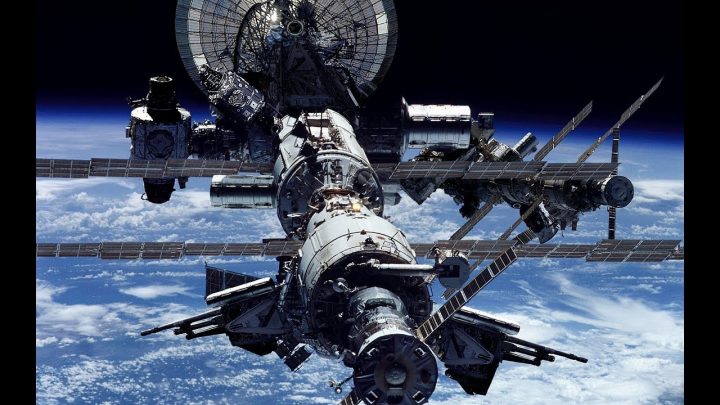
The International Space Station (ISS) is a space station, or a habitable artificial satellite, in low Earth orbit. Its first component launched into orbit in 1998, the last pressurised module was fitted in 2011, and the station is expected to be used until 2028. Development and assembly of the station continues, with components scheduled for launch in 2018 and 2019. The ISS is the largest human...

Hanny’s Voorwerp

H

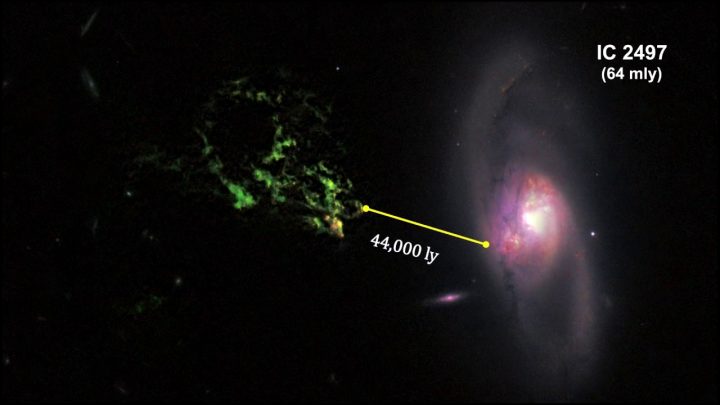
Hanny’s Voorwerp is a very rare type of astronomical object called a quasar ionization echo. It was discovered in 2007 by Dutch school teacher Hanny van Arkel, while she was participating as a volunteer in the Galaxy Zoo project. Photographically, it appears as a bright blob close to spiral galaxy IC 2497 in the constellation Leo Minor. One hypothesis suggests that HsV consists of remnants...

Goldilocks Planets

G

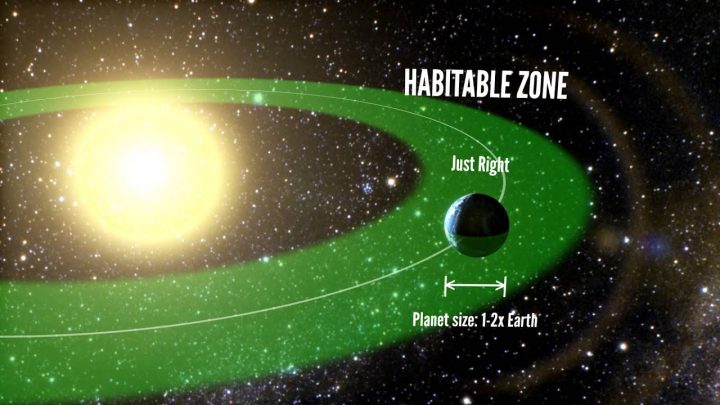
A Goldilocks planet is a planet that falls within a star’s habitable zone, and the name is often specifically used for planets close to the size of Earth. The name comes from the children’s fairy tale of Goldilocks and the Three Bears, in which a little girl chooses from sets of three items, ignoring the ones that are too extreme (large or small, hot or cold, etc.), and settling on...

Gamma Rays

G

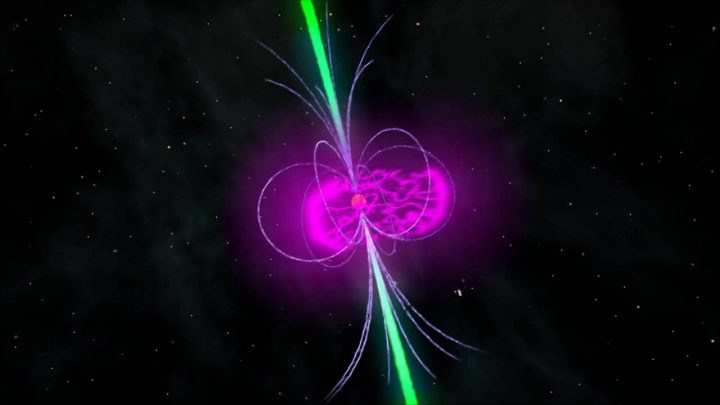
Gamma rays (also called gamma radiation) are penetrating electromagnetic radiation of a kind arising from the radioactive decay of atomic nuclei. It consists of photons in the highest observed range of photon energy. Paul Villard, a French chemist and physicist, discovered gamma radiation in 1900 while studying radiation emitted by radium. In 1903, Ernest Rutherford named this radiation gamma...

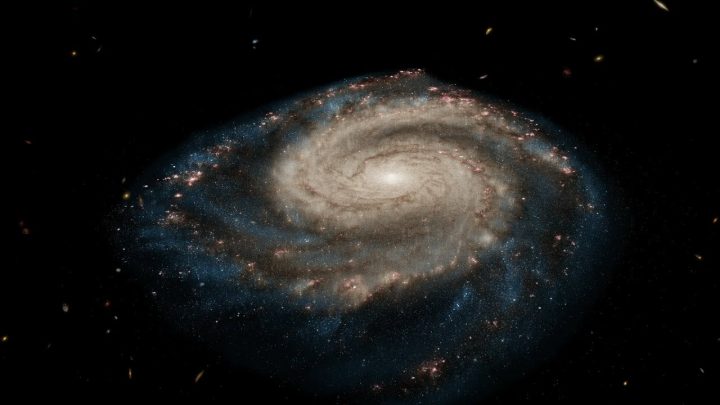
Whirlpool Galaxy

W

Whirlpool Galaxy Deep Field NASA – May 26, 2009 Many spiral galaxies have bars across their centers. Even our own Milky Way Galaxy is thought to have a modest central bar. Prominently barred spiral galaxy NGC 6217, pictured above, was captured in spectacular detail in this recently released image taken by the newly repaired Advanced Camera for Surveys on the orbiting Hubble Space...