CategoryTechnology

Neutrinos

N

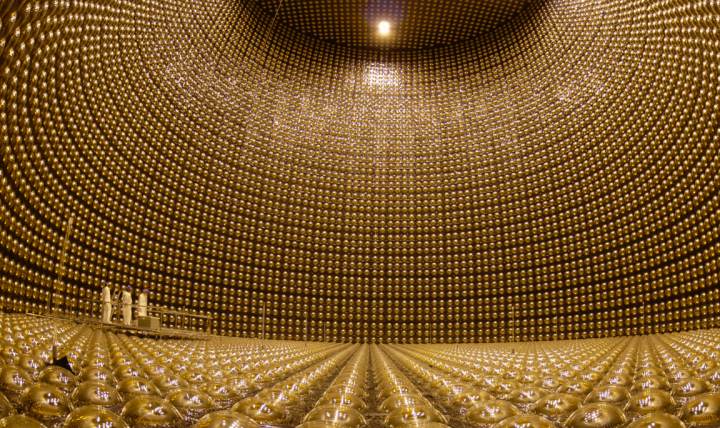
The neutrino is an elementary particle. It has fractional spin and is therefore a fermion. Its mass is very small compared to most other particles, although recent experiments (see Super-Kamiokande and Sudbury Neutrino Observatory) have shown it to be nonzero. Since it is an electrically neutral lepton, the neutrino interacts neither by way of the strong nor the electromagnetic force, but only...
Neptune

N

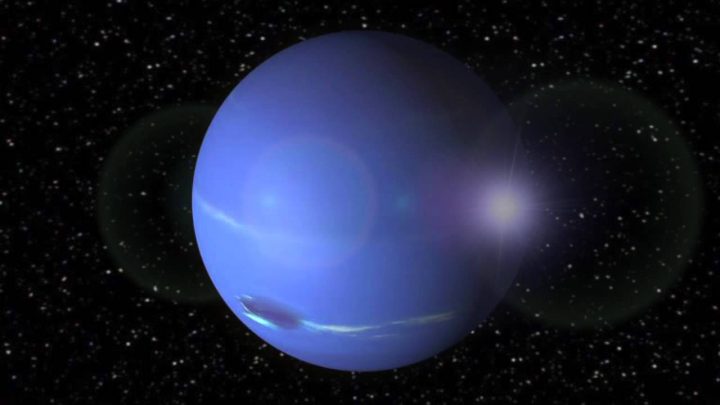
 Size: 49 500 km diameter (3.9 x Earth)  Surface Temperature: -240°C  Atmosphere: 86 parts Hydrogen 19 parts Helium 1 part Methane  Spin: 16 hours 7 minutes  Year: 163 years 9 months  Moons: Naiad Thalassa Depoina Galatea Larissa Proteus Triton Nereid Neptune is the eighth or, occasionally, the ninth planet from the Sun due to Pluto’s eccentric orbit, and the...

Music of the Spheres

M

Musica Universalis or Music of the Spheres is an ancient philosophical concept that regards proportions in the movements of celestial bodies – the sun, moon, and planets – as a form of musica – the medieval Latin name for music. This music is not audible, but simply a mathematical concept. The Greek philosopher Pythagoras is frequently credited...

Earth’s Moon

E

The Moon is an astronomical body that orbits planet Earth and is Earth’s only permanent natural satellite. It is the fifth-largest natural satellite in the Solar System, and the largest among planetary satellites relative to the size of the planet that it orbits (its primary). The Moon is after Jupiter’s satellite Io the second-densest satellite in the Solar System among those whose...

Meteoroid, Meteors, and Meteorites

M

A meteoroid is a small rocky or metallic body travelling through space. Meteoroids are significantly smaller than asteroids, and range in size from small grains to 1 meter-wide objects. Most are fragments from comets or asteroids, while others are collision impact debris ejected from bodies such as the Moon or Mars. The visible streak of light from space debris is the result of heat as it enters...

Mercury

M

Mercury is the innermost planet in the Solar System. It is also the smallest, and its orbit is the most eccentric (that is, the least perfectly circular) of the eight planets. It orbits the Sun once in about 88 Earth days, completing three rotations about its axis for every two orbits. The planet is named after the Roman god Mercury, the messenger to the gods. Mercury’s surface is heavily...

Could Life Have Evolved on Mars Before Earth?

C

March 13, 2013 Martians … Entities from Mars … are all part of the things we read about or see in media. We find references to Martians in films, literature, channelings, art, alien abductions, and perhaps physical evidence found across the landscape of planet Earth and below the surface. Many believe. Others don’t. None of it seems important without the physical proof so many...

Mars

M

Mars is the fourth planet from the Sun and the second-smallest planet in the Solar System after Mercury. In English, Mars carries a name of the Roman god of war, and is often referred to as the “Red Planet” because the iron oxide prevalent on its surface gives it a reddish appearance that is distinctive among the astronomical bodies visible to the naked eye. Mars is a terrestrial...

Lagrange Points

L

Lagrange Points also L-points, are the five positions in an orbital configuration where a small object affected only by gravity can theoretically be stationary relative to two larger objects (such as a satellite with respect to the Earth and Moon). The Lagrange points mark positions where the combined gravitational pull of the two large masses provides precisely the centripetal force required to...

Lyra

L

A small but bright northern constellation lying between DECL=+30 and DECL=+40 and RA=18h and RA=19h. The fifth-brightest star of the sky, alpha Lyr, called Vega (arabic for “stone eagle”), radiates from the top Lyra with a pure white colour. Together with alpha Cyg, Deneb , and alpha Aql, Atair, Vega forms the Summer Triangle. Stars and other objects Beta Lyr is a half separated (i.e...