AuthorHMS

Valley of the Queens

V

The Valley of the Queens, also known as Biban el-Harim, Biban el-Sultanat, and Wadi el-Melikat, is a place in Egypt where wives of Pharaohs were buried in ancient times. In ancient times, it was known as Ta-Set-Neferu, meaning – ‘the place of the Children of the Pharaoh’, because along with the Queens of the 18th, 19th and 20th dynasties (1550-1070 BCE) many princes and...

Valley of the Kings

V

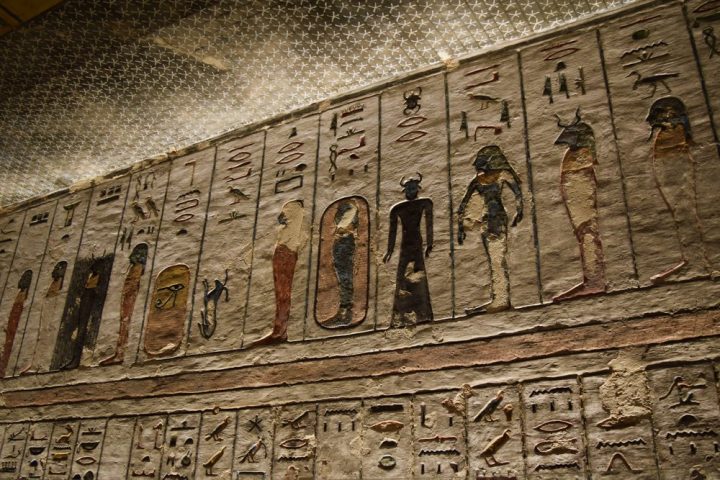
The Valley of the Kings is a valley in Egypt where for a period of nearly 500 years from the 16th to 11th century BC, tombs were constructed for the kings and powerful nobles of the New Kingdom (the Eighteenth through Twentieth Dynasties of Ancient Egypt). The valley stands on the west bank of the Nile, across from Thebes (modern Luxor), within the heart of the Theban Necropolis. The wadi...

Uraeus

U

The Uraeus is a symbol for the goddess Wadjet, one of the earliest of Egyptian deities, who often was depicted as a cobra. The center of her cult was in Per-Wadjet, later called Buto by the Greeks. She became the patroness of the Nile Delta and the protector of all of Lower Egypt, so her image was worn by the pharaohs as a head ornament, first as the body of Wadjet atop the head or as a crown...

Trees in Ancient Egypt

T

Egypt, before the dawn of history was teeming with trees. Of these trees are the petrified forests that are near the Giza pyramids and beside El Mokattam plateau. Egyptian Pharaohs planted trees and took care of them. They brought ebony wood from the Sudan, pine and cedar from Syria. Egyptian Pharaohs planted sant trees, sycamore, lotus fruits and willow. At the time of the Crusades, Egypt had...

King Tutankhamen

K

Tutankhamun (approx. 1341 BC – 1323 BC) was an Egyptian pharaoh of the 18th dynasty (ruled ca. 1333 BC – 1323 BC in the conventional chronology), during the period of Egyptian history known as the New Kingdom. His original name, Tutankhaten, means “Living Image of Aten”, while Tutankhamun means “Living Image of Amun”. In hieroglyphs, the name Tutankhamun was...

Hoag’s Galaxy

H

Hoag’s Object is a non-typical galaxy of the type known as a ring galaxy. The appearance of this object has interested amateur astronomers as much as its uncommon structure has fascinated professionals. The galaxy is named after Arthur Allen Hoag who discovered it in 1950 and identified it as either a planetary nebula or a peculiar galaxy with eight billion stars. A nearly perfect ring of...

Ancient Egyptian Symbols

A

Amenta This symbol represents the Underworld or Land of the Dead. Originally it meant the horizon of the sun set. Later, it became the symbol of the west bank of the Nile, where the sun set and also where the Egyptians traditionally buried their dead. Akhet This symbol represents the horizon from which the sun emerged and disappeared. The horizon thus embodied the idea of both sunrise and sunset...

Archaeology in Space

A

Archaeology of a million stars to unravel galaxies’ evolution April 9, 2015 Our archaeology of space is a new era in astronomy and the knowledge gained promises to be every bit as exciting and important as anything discovered on Earth. Archaeology is no longer earthbound but is being used to solve one of the fundamental mysteries of astronomy. We still don’t understand how the more...

Class System and Careers

C

Social Pyramid At the top of the social pyramid was the Pharaoh who was not simply a king and a ruler, but was considered a god on earth. The vizier was the pharaoh’s closest advisor. Next came the high priests and noblemen whom the pharaoh appointed as his assistants, generals, and administrators, who together formed the government. Lesser Priests were the teacher, healers, and often...

Ancient Egyptian Science and Technology

A

The characteristics of ancient Egyptians are indicated by a set of artifacts and customs that lasted for thousands of years. The Egyptians invented and used many basic machines, such as the ramp and the lever, to aid construction processes. They used rope trusses to stiffen the beam of ships. Egyptian paper, made from papyrus, and pottery was mass produced and exported throughout the...